Calyx Intelligence
We build verified public-record corpora on data center siting, power and public finance — and governed AI systems for firms whose work gets examined.
Every entry is sourced, dated, and marked for how it was obtained. Conflicts between sources are recorded with both values and neither is resolved silently. Every entry says whether its primary source was read in the original or taken from reporting. Documents delivered to a client — dossiers, source packages, measurement reports — are hashed at delivery, so the recipient can verify that nothing changed after it left our hands.
Three findings published. None commissioned by any party. We sell to lenders, to developers, to counties, to utilities, and to the people opposing them. The record says what it says regardless of who asked.
Data centers · verified public record
A national register of what cities, counties, tribal nations and utilities have actually adopted on data center siting, power and public finance. As of October 7, 2026: 515 provisions across 277 jurisdictions in 43 states, plus federal and multi-state entries. Every entry names the document it came from and whether it was read in original.
Where the rules are being written
Instruments per state in the register
Point at a state to see what the register holds.
New in the register
The five most recent entries read in original.
Three findings published, none commissioned by any party. We sell to lenders, to developers, to counties, to utilities, and to the people opposing them.
For counties convening a task force: A Framework for Public Deliberation on Data Center Siting — an operating framework with model charter clauses, free to adopt, modify, or reproduce.
The data center practice → · Search the register → · See a sample report → · What it costs →
What changes under a site between term sheet and final draw.
Construction debt now clears in days. The rules under a site move in county meetings over months: moratoriums, permit pauses, new conditions on power and water. The lender package reads them in the original for a specific site, and keeps reading until the loan is drawn.
- 01Lender package.Every rule in force and in motion at the city, county, utility, state and federal level, each read in the original and dated, plus the entity and land records behind the borrower.
- 02Draw-day bring-down.A short check before each draw for anything that changed under the site since the last one.
- 03Monitoring.A standing watch on a site's dockets, permits and filings, with dated notice when something moves.
The same findings go to any buyer, and Calyx takes no position on whether a project should be built. A sample lender package is available on request; a sample jurisdiction report is public. Lender work is quoted per site; entry prices are published.
Four rules, and each one costs us something.
- 01Same price for either side.What we charge does not depend on which side of a project you are on or how it comes out. Public-sector help — comparison sheets, the Framework — is free, on the record, and never paid for by an applicant.
- 02Disclose the conflict.Public bodies are named with scope and amount. Private engagements are confidential by default and counted by type of client — lender, developer, county, utility, opponent — and named only if they agree. Any published finding that touches a paid engagement says so on its face.
- 03Sell to both sides in the same market.Stated at intake. Neither engagement changes what the record says. We do not sell to a jurisdiction and to an applicant before that jurisdiction.
- 04Grade our own client's numbers the same way.The first time a client's figure does not reconcile, they hear it privately and first. Soften it once and there is no way back.
Calyx holds no position on whether data centers should be built, where, or under what incentives. Where a client wants a recommendation it comes from a named human in a separately signed document, identified as judgment sitting on top of verified facts. A verifier who quietly advocates is an advocate with better sourcing.
Site survey and field measurement work is a Calyx Intelligence practice. Southwest Energy Group LLC remains a separate Arizona company building deployable solar generation and storage for construction-phase and temporary site power.
Governed AI, running in production for a year.
The same discipline, applied inside a firm rather than to a public record. On hardware the firm owns, behind its own firewall, with no path to the outside.
It reads the firm's documents, drafts its work, and answers questions from the firm's own material. No egress. No telemetry. No remote access. Nothing is released until a named person reviews it, and every release is sealed. So when a client, a carrier or a court asks how the work got done, you show them instead of explaining.
Governance by design, not retrofit.
From how a question gets reasoned through to the cryptographic seal on the released output. The point is not the layers. The point is that every decision has a path you can retrace and a person whose name is on it.
Reasoning
Structured reasoning discipline
Constraints
Operational constraints and authority boundaries
Provenance
Audit and provenance spine
Scenarios
Scenario engine — ranked outcomes
Signal
Contextual signal evaluation
Oversight
Human oversight control plane
Continuity
Continuity and state awareness
Evidence
Cryptographic evidence binding — the final defense
A year of live operation, not a case study.
Calyx architecture has run daily inside a working accounting practice since September 2025 — through a full filing season, a year-end close, a client dispute, and an insurance renewal. Not a pilot. Not a demonstration.
A compliance firm now does advisory work. That is a change in what business the firm is in, not an efficiency gain.
At renewal, the carrier reviewed the governance framework and wrote the AI systems into coverage. Carriers are not refusing to cover AI. They are refusing to cover AI they cannot evaluate.
Every system produces work. Almost none produce proof.
At the moment a person releases something, LedgerGuard binds the output, its sources, the model that produced it, the human who signed it, and the time into one tamper-evident record.
Anyone holding a copy can verify it with standard tools and no cooperation from us. That last part is the whole point — a record only the vendor can confirm is not evidence.
The same stack, shaped to how each domain gets examined.
Each engine inherits the full governance stack and is built for reconstruction and audit survivability, not just output generation.
Five of six production verticals shown. Financia covers banking and financial services.
An operator runs it inside the firm.
That is the difference between software a firm buys and a capability a firm has. The operator learns how the practice actually works, builds the library around it, and stays until the firm can run it themselves — at which point the engagement converts to a license.
Situational Awareness Assessment
Before deployment, before remediation, before the larger engagement — know where you actually stand. A scoped diagnostic across tax and entity structure, audit exposure, procedural readiness, AI governance, insurance defensibility, and multi-vertical operational risk. Written findings, an exposure map, remediation pathways, and a working session with leadership.
Active matter support
Reasoning infrastructure for live litigation, audits, regulatory examinations, and time-pressured decisions.
Continuous operational engagement
Multi-vertical deployment with integrated governance across legal, financial and regulatory domains.
Incident reconstruction
Post-event provenance reconstruction, defensibility documentation, and audit response. When a decision is challenged, this is where the architecture proves its value.
Deployment & integration
Moving assessment findings into governed infrastructure. Engine activation and governance integration with existing operations.
Site survey & field measurement
Acoustic (including low-frequency hum and infrasound), vibration, RF spectrum, power quality, light and environmental path screening. Baseline before construction, compliance verification after. Measurement and documentation — design and certification route to a stamped engineer.
Working notes, not marketing.
Each one starts from an event, a pattern, or an architectural problem seen in the field, and reasons through what it means for institutions operating under real constraints.
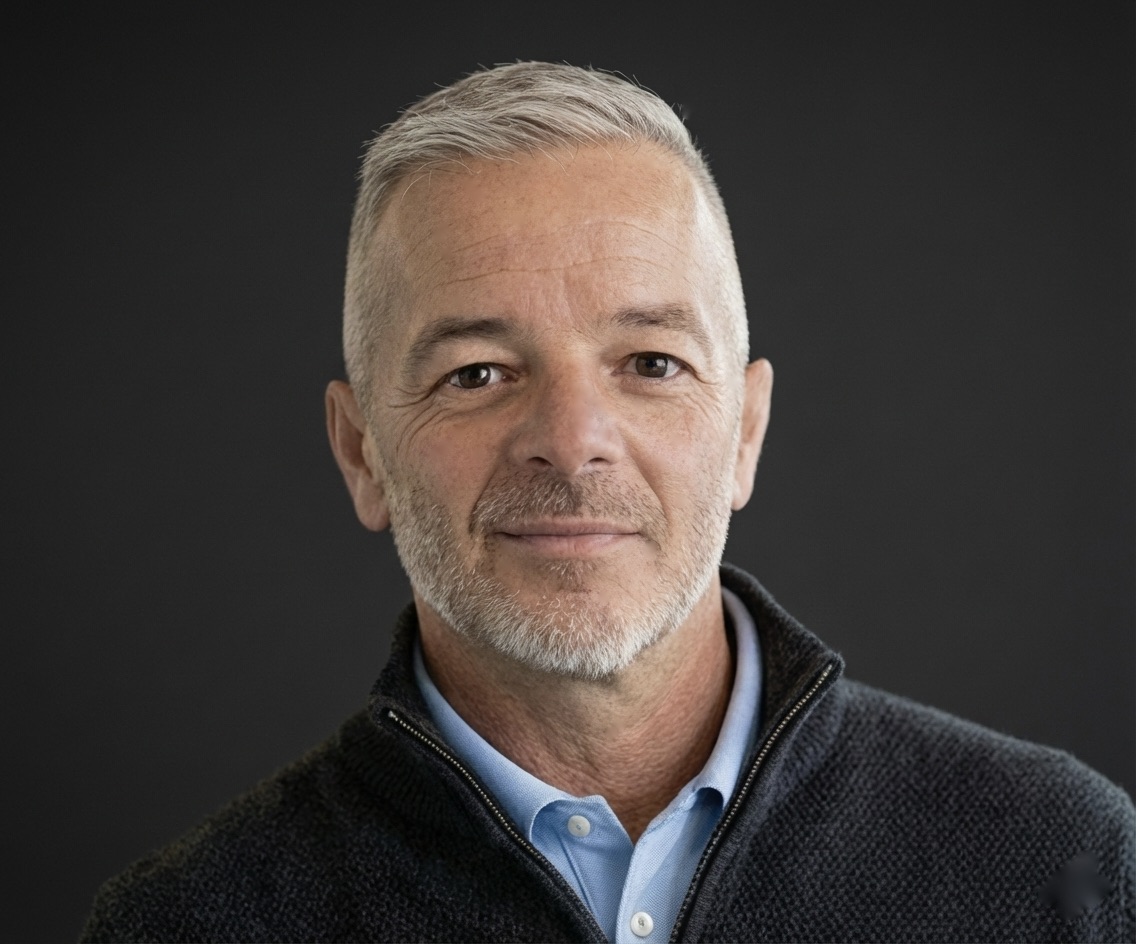
Michael Lawrence
Founder & Systems Architect, Calyx Intelligence · Scottsdale, Arizona
Three decades of field engineering before any of this. Communication site development — site identification, land control, utility extension, backhaul, power, construction, commissioning — with FCC signal planning and RF propagation. SCADA networks under federal oversight, remote-control systems for federally regulated water systems, and FEMA contract work restoring emergency telecommunications.
Pre-acquisition engineering on a 660,000 square foot industrial building, including noise, vibration and radiation testing, rail access and city planning review. More than three million square feet of Phoenix-valley industrial property evaluated alongside leasing agents, contractors and builders — including the rooftop solar and behind-the-meter battery systems designed and negotiated on those buildings. Concrete tilt-up, abatement, utility staging, access and egress.
Hillsboro, Oregon originally. A career spent building systems that are not allowed to fail quietly, which is precisely the discipline this work demands. Not a licensed engineer; work requiring a stamp goes to a stamped engineer.
He is the author of the governance concepts vigilance decay — where institutions adopt strict AI policies but never enforce verification at the moment of execution — and consent drift. A third principle runs underneath both: you can fabricate the instrument, but you cannot fabricate the authority's record of it.
Start the conversation.
A site or market question, a jurisdiction corpus, an assessment, or a deployment — write directly and say which.