A straight answer on one site.
Whether you are deciding to build on a site, reviewing one, or living next to one, we read the site and the record behind it and put the answer in writing, signed by the person who made it. Same work and same price, whoever asks.
Signed by Michael Lawrence, who has spent decades in the field building communication sites, utility power and extensions, backhaul, SCADA networks, construction and commissioning. The rules side comes from the Calyx public register of data center siting rules, where every entry is sourced and dated.
Send us the site and your question →
No site yet? Site Search finds them against your spec and reads each one.
If you are deciding whether to pursue a site
For developers, buyers, lenders and anyone else with money on the line. The verdict ends in one of four calls.
Go
"The site is doable."
Nothing found that stops it. You get the three things to lock down next.
Go with conditions
"Viable, once these are met."
Each condition is named, with who clears it, by when, and what happens to the site if it doesn't clear.
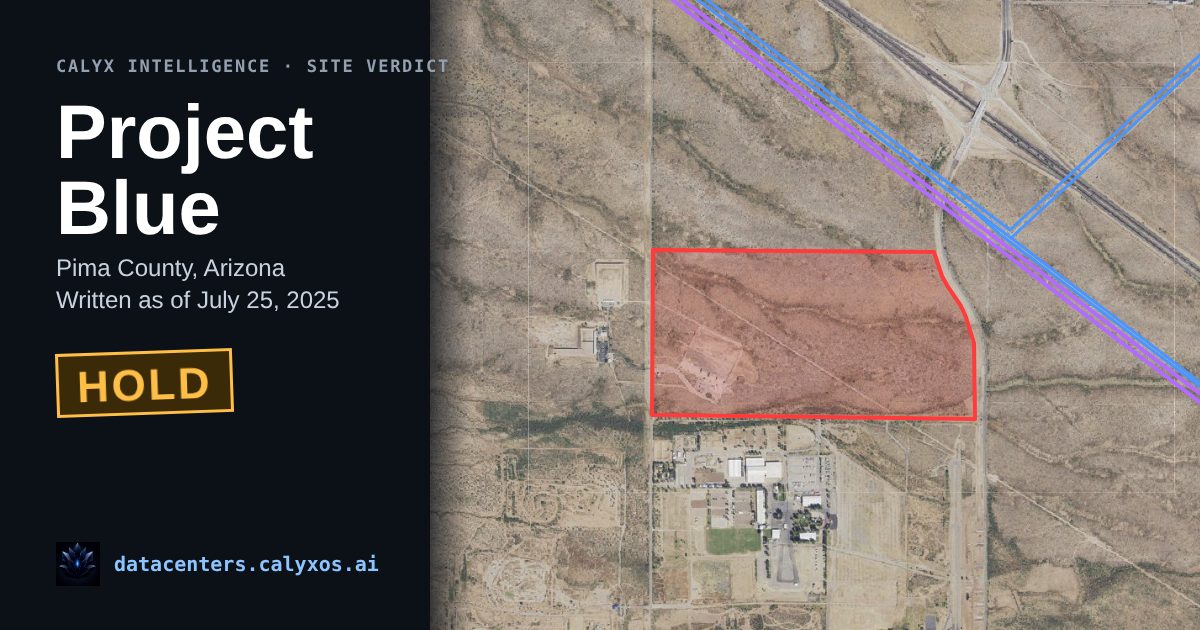
Hold
"Not yet. A dated event decides it."
A known event will decide this site: a vote, a tariff order, a pause that expires, a letter from the utility. You get the event, its date, and what moves the call either way.
No-go
"I'd walk away from this one."
Don't spend more here. The reason is stated plainly.
A Hold always names the event and its date. Without them it would only be a hedge. A site called Hold can stay on Watch monitoring until the event happens, and the call is made again when it does.
If you are reviewing a site, or live near one
For cities, counties, states, utilities, neighbors and the groups that represent them.
What this site will do
Power, water, sound, traffic, the rules that apply, and what is still unresolved.
The same read of the site, ending in what the record and the ground show rather than a call. Where it matters, we measure: a sound baseline at the property line before anything is built, so there is a real number to compare against later. We do not tell a council how to vote. That decision belongs to the people who answer for it.
A real site, written before the vote.
We wrote a full verdict on a real data center site using only what was public before the deciding vote, then added what actually happened. It is shared on request.
Record, site, call.
- 01Read the recordThe rules that apply to the site and the dates that matter: local pauses, ordinances, pending votes, state holds, tariff and large-load terms, and incentive terms. These come from the register, each entry with its source.
- 02Read the siteWe look at access and egress, utility entry points, the infrastructure already there, and what sits on the other side of the fence. The read comes from current and historical imagery, local photographs and video when they're needed, or a site visit when the call depends on being there. The verdict says which method was used, and the date.
- 03Bring in licensed work where it's neededEnvironmental, survey, geotechnical, stamped acoustic studies and air permitting are done by licensed firms under the engagement, and each is cited in the verdict by firm and date. Fire code is read by an independent fire code firm, under a short agreement directly with you, and their read is cited in ours. When a finding needs a seal, a licensed professional engineer in the site's state stamps it.
- 04Sign the callYou get one word, one paragraph and the evidence underneath, plus what would change the call.
What we look at, for anyone asking.
| Area | What you get |
|---|---|
| Power | What the utility has committed in writing, what is still open, and the tariff, study and security terms you will be asked to post. Where it matters, power quality is measured at the service and at the neighbors. |
| Rules and dates | Pauses, ordinances, pending votes and state holds that reach the site, each with its source and the date it was checked. |
| Zoning path | Whether it is by right or discretionary, and the conditions likely to be attached. |
| Water and wastewater | Who serves the site and what they have said about capacity, plus groundwater, wells and the drought and supply outlook that could limit cooling water. |
| Fiber | Routes, entry and distance to carriers. |
| Sound | The noise rule that will apply, and a measured baseline where it matters. |
| Fire | What the fire department is likely to require: access, water for firefighting at the street, battery yards and bulk fuel, and any local data center fire rules. Read by an independent fire code firm. |
| Community | What the record shows: past votes, how similar applications fared, and organized opposition on file. |
| Your drawings | With plan review: your plans and the city's and utilities' drawings on one map, with every conflict listed. |
| The ground | Access, staging, adjacent uses, and what's visible standing on the parcel. |
Priced before we start.
Screen
$7,500 · one site · 5 business days
A quick read of the record and the imagery. For someone deciding, it ends in one of two answers: worth a verdict, or no-go. For a reviewer, it ends in the questions a full verdict should answer. A screen is never called a verdict. If you order a verdict within 60 days, the fee is credited toward it.
Verdict
From $15,000 · one site · 3 weeks
The full verdict: one of the four calls, or for a reviewer, what the site will do. The site is read from imagery, with local photographs and video when they're needed.
| Project size | Verdict | Field Verdict |
|---|---|---|
| Under 100 MW or under $500 million | $15,000 | from $25,000 |
| 100 to 500 MW or $500 million to $3 billion | $25,000 | from $40,000 |
| Over 500 MW or over $3 billion | $40,000 | from $60,000 |
Priced by the size of the decision, not the hours, and the same for either side.
Field Verdict
From $25,000 plus travel, by project size as above · one site · 4 weeks, including one to two days on site
The full verdict, with the site walked in person. Use it for contested sites, sites where noise will be a condition, or when the call depends on what you can only see standing there. A sound baseline adds $5,000. Power quality recording adds $5,000.
Plan review
+$5,000 with a verdict · $10,000 on its own
Every drawing for the site on one map: your site plan, plat, survey and renderings, laid over the city's sewer and water drawings, zoning and setbacks, floodplain, easements, fiber routes and the nearest substations and lines. You get a layered Google Earth file, a one-sheet map, and a list of every place the drawings disagree, with who should resolve each one. We find the conflicts. Resolving them stays with the engineer of record.
Campus Verdict
From $50,000 · multiple parcels or phases · scoped
The same call for a larger site, scoped to the parcels and the load.
Fire code read
Optional · quoted with ours · contracted and paid directly with the fire firm
What the fire department is likely to want for the site, prepared by an ICC-certified fire plans examiner at an independent fire code firm that is not affiliated with any fire department. With a Screen, it comes back in three business days. With a Verdict, it comes back within ten business days of the site plan. You sign a one-page agreement with the fire firm and pay them directly, at the rate they give clients we refer. Their read is cited in ours by firm and date.
Stamped engineering
Quoted per job · contracted directly with you
Civil, electrical or structural work that needs a seal, done by a licensed professional engineer in the site's state. The engineer signs with you directly, so the stamp and its responsibility stay with the engineer. Their work is cited in ours by name and date.
Watch monitoring
$1,500 · per site, monthly
For sites called Hold or Go with conditions. We follow the trigger through to the date it happens, and the call is made again when it does.
Still looking for the site? A Site Search brings you a shortlist, and $7,500 of a delivered site's fee is credited toward its verdict. Need the record before a call? A site record is $3,500. No contingent fees: the price is the same whatever the call. Turnaround runs from the signed engagement letter and receipt of your drawings.
We give our read on where a place is headed, signed and dated, with the odds. Available on Site Verdicts, jurisdiction reports and quarterly outlooks. The Desk Read →
One site, read the same way for either side.
Calyx holds no position on whether data centers should be built. A verdict doesn't change that. It is one named person's judgment about one site for one client. It is signed separately and identified as judgment sitting on top of verified facts.
- The register reads the same whether or not anyone bought a verdict.
- We never work for both a government deciding a site and the applicant before it. Before we take a site we check, and if we already work for one side of that decision, we decline the other.
- We don't take a verdict on a site that is the subject of an unpublished register finding.
- Neither Calyx nor its founder holds or pursues an interest in a site we are paid to call. Any land interest the founder holds in the same county is disclosed to you in writing before the engagement.
- Where power is short, the verdict states the gap. It does not recommend on-site generation or storage, a category in which the founder has a disclosed adjacency.
- Verdicts and your drawings are confidential. One client's information never reaches another, and nothing you give us goes into the register.
What a verdict is, and isn't.
It is
- A feasibility opinion on one site: whether to pursue it, or what it will do
- Grounded in a sourced record and a dated read of the site
- Signed by a named person
It isn't
- Engineering design or certification
- A legal or title opinion
- An appraisal
- A promise of approval
Calyx is not a licensed engineering firm. Work that requires a stamp is done by a licensed engineer and cited. Legal questions go to your counsel, and title to your title company.
Send us the site and your question →
You'll get a price and a date back in writing.