Field measurement
A site survey records what a property sounds like, how it vibrates, and what is in the air around it before anything is built, then measures the same things the same way afterward. The difference between the two is the finding.
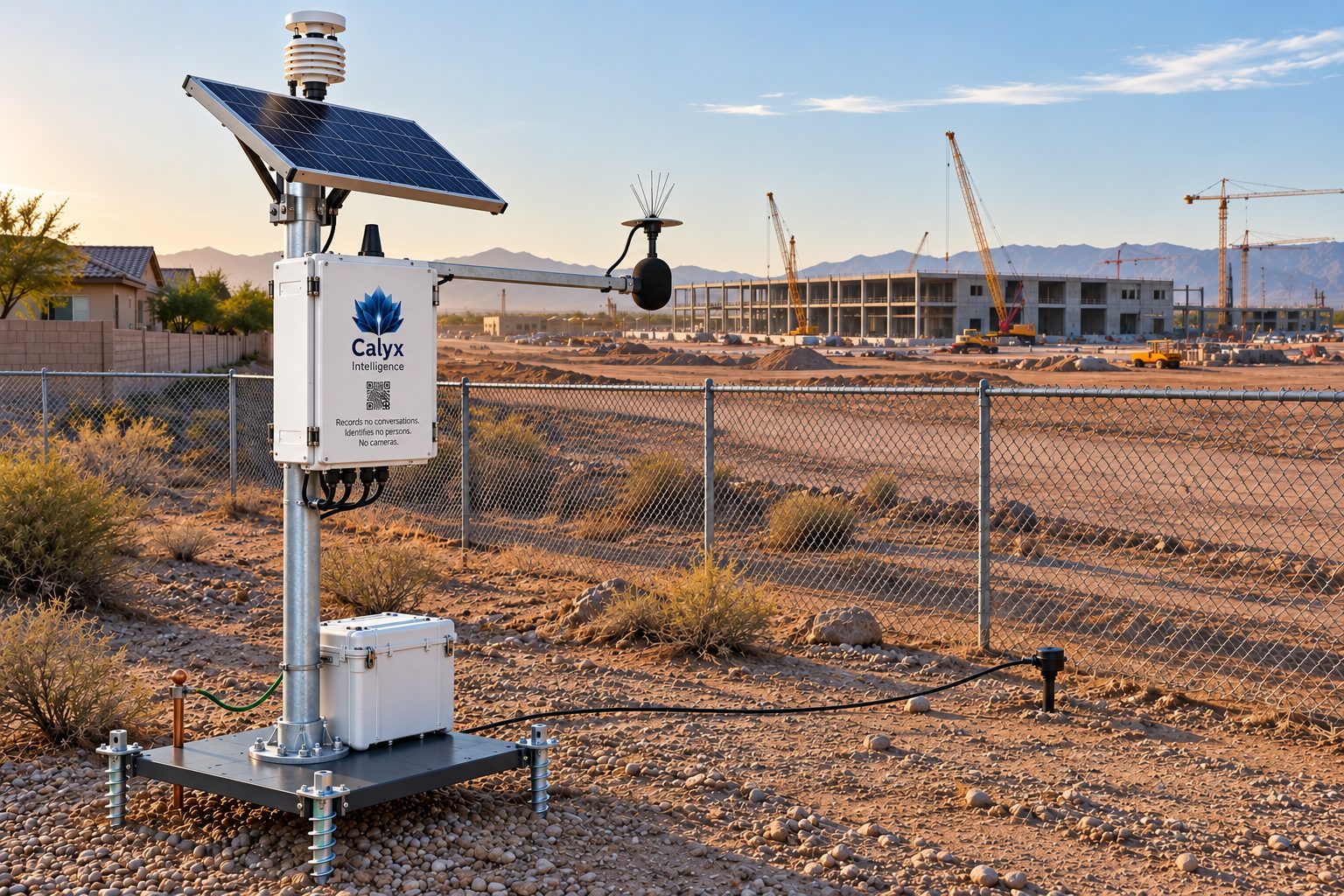
When an approval says a project must "comply with the noise ordinance," someone eventually has to stand at the property line with a calibrated instrument and produce a number that holds up in front of a council, a neighbor, and possibly a court. Most projects find that out after the first complaint, when the only record of what the site used to be like is the complaint itself.
What it costs. The level depends on how long the measurement has to stand.
- Spot survey. We are on site for up to 24 hours, measuring at one to three positions. Added to a Site Verdict, a sound baseline is $5,000 and a power quality recording is $5,000. Those prices are for Arizona sites; elsewhere, travel is added at cost.
- Baseline campaign. Three anchored Field Nodes go in once the site is leveled and record for at least 30 days before construction starts.
- Construction and operations monitoring. The nodes stay through construction and opening, and through any follow-up study the approval requires.
Campaigns and monitoring are quoted per site: a one-time mobilization fee plus a monthly rate per node. Every fixed price is on one page: calyxos.ai/pricing.
How a survey runs
Four stages across the life of a project. The first is the one people miss: once construction starts, the undisturbed site is gone and can't be measured again.
- 1
Before construction: the baseline
We record sound over at least a full day and night, not a few minutes in the afternoon, at the property line and at the nearest neighbors, and ground vibration at adjacent buildings, with weather logged throughout. We also photograph the condition of neighboring structures. You get: a dated record of what the site was like before work began.
- 2
During construction: monitoring
Vibration sensors run continuously. Anything over a set threshold is captured with its exact time. You get: a way to answer a complaint with what actually happened, and when.
- 3
After construction: verification
We go back to the same positions and repeat the same measurements with the same instruments and the same method. You get: the change from baseline, stated as a measurement.
- 4
Ongoing: continuing compliance
Where an approval requires measurement after the facility opens, the survey follows that schedule. Chandler, for one, requires a study at occupancy and every year for five years after. You get: a consistent record over time, measured the same way each time.
The field node
A self-contained measurement station that stands at one position for the length of a project. It runs on solar power, records continuously, and reports home over the cellular network, so nobody has to visit it to collect data.
- Sound and humA Class 1 sound level meter, microphone on an arm at 1.5 m. A- and C-weighted levels, plus third-octave bands down into the low frequencies, so a steady hum shows up as a named frequency. Levels and frequency bands only; no audio is recorded.
- InfrasoundA pressure sensor for sound below 20 Hz: the low rumble people describe feeling rather than hearing. Logged continuously alongside the sound meter.
- Ground vibrationA three-axis seismic sensor set in the ground several meters from the node, away from its own wind movement, recording continuously.
- WeatherWind, temperature, humidity and pressure, logged with every reading so readings compare fairly.
- Time and recordEvery sample GPS-timestamped. Each day's file is hashed on the node before it is sent, and checked again on arrival.
- PowerSolar panel above the enclosure, which also shades it; battery sized for five days without sun.
- SecurityDoor, tilt and position alerts. No cameras, by design.
What gets measured, and why it matters
Each measurement answers a question someone is going to ask: a neighbor, a council, an underwriter. The right-hand column is the method, for the engineer reviewing the work.
| Measurement | The question it answers | How it's measured |
|---|---|---|
| Sound | How loud is it at the property line, day and night, and is there a hum? Chillers, fans and transformers make a steady tone that people notice more than its loudness alone suggests. | Class 1 sound level meter to IEC 61672. A- and C-weighted levels side by side, so a low-frequency hum can't hide behind an A-weighted number. Third-octave bands to 20 Hz; day, evening and night statistics; tonal peaks named by frequency. |
| Infrasound | Is there a rumble below hearing that people near the site say they feel? | Pressure sensor below 20 Hz, logged continuously and time-aligned with the sound meter. Reported as measured; there is no adopted U.S. limit to compare it against. |
| Vibration | Is construction or equipment shaking nearby buildings, and can people feel it? | Three-axis seismic sensor, continuous, for ground motion and what people feel. Peak particle velocity at a structure is measured with a blasting-grade monitor where the engagement calls for it. Two different limits. |
| Power quality | Is the facility putting distortion, flicker or voltage swings onto the lines its neighbors share? | Recorded at the facility's metering and at neighboring services: voltage and current harmonics, flicker and voltage events, read against IEEE 519. |
| Light | Is light spilling onto neighboring property, or causing glare? | Illuminance and luminance at the property line, for trespass and glare. |
| Site conditions | What were the wind, temperature and humidity when each reading was taken? | Logged with every reading, so readings taken months apart compare fairly. |
Standards review, before anyone measures
A measurement is only useful against a rule that says what to measure and what counts as a problem. Many local noise rules leave out the parts that make them enforceable. For a city or county, we read its noise rule against five elements:
- A number. A limit at a defined point, such as the property line or the nearest home, with separate day and night values.
- A method. How the sound is measured: the weighting, the averaging period, and the class of instrument.
- A tone rule. A penalty for a steady hum. Many rules measure in a way that underweights low-frequency sound, which is where most equipment noise sits.
- Who measures, and how often. An independent party on a set schedule, or the operator.
- A consequence. What happens when a site exceeds the limit, and by when it has to be fixed.
We also note whether the rule applies only to new projects or to existing facilities as well. The result is a desk review: which elements the rule has, which it lacks, and how other jurisdictions in our public register wrote the missing pieces. Drafting and adopting any change stays with the jurisdiction and its attorney.
What a report says, and what it doesn't
A report states
- What was measured, where and when
- Which instrument, and its calibration
- The conditions at the time
- The published standard it was measured against
A report does not state
- Whether a site complies. The jurisdiction decides that.
- Whether a level caused damage. That is a structural engineer's call.
- Anything about health effects.
- Any professional stamp, or anything implying one.
Every delivered report carries a SHA-256 hash, recorded in the delivery email, so the recipient can confirm the file hasn't changed since it left us.
Who uses it
Developers and builders with a measurement condition in their approval. Owners facing a neighbor complaint with no record to answer it. Attorneys who need a factual account of what was measured, not an opinion on what it means. Cities and counties that wrote a noise or vibration condition and have no way to check it. Insurers and lenders who need a dated record of a site's conditions before a policy binds or a draw funds.
The work draws on thirty years of communication site development, from land and permitting through radio frequency planning, utility power, construction and commissioning, along with SCADA networks under federal oversight and behind-the-meter power design across roughly three million square feet of industrial property. Calyx is not a licensed engineering firm; anything requiring a stamp goes to a licensed engineer.
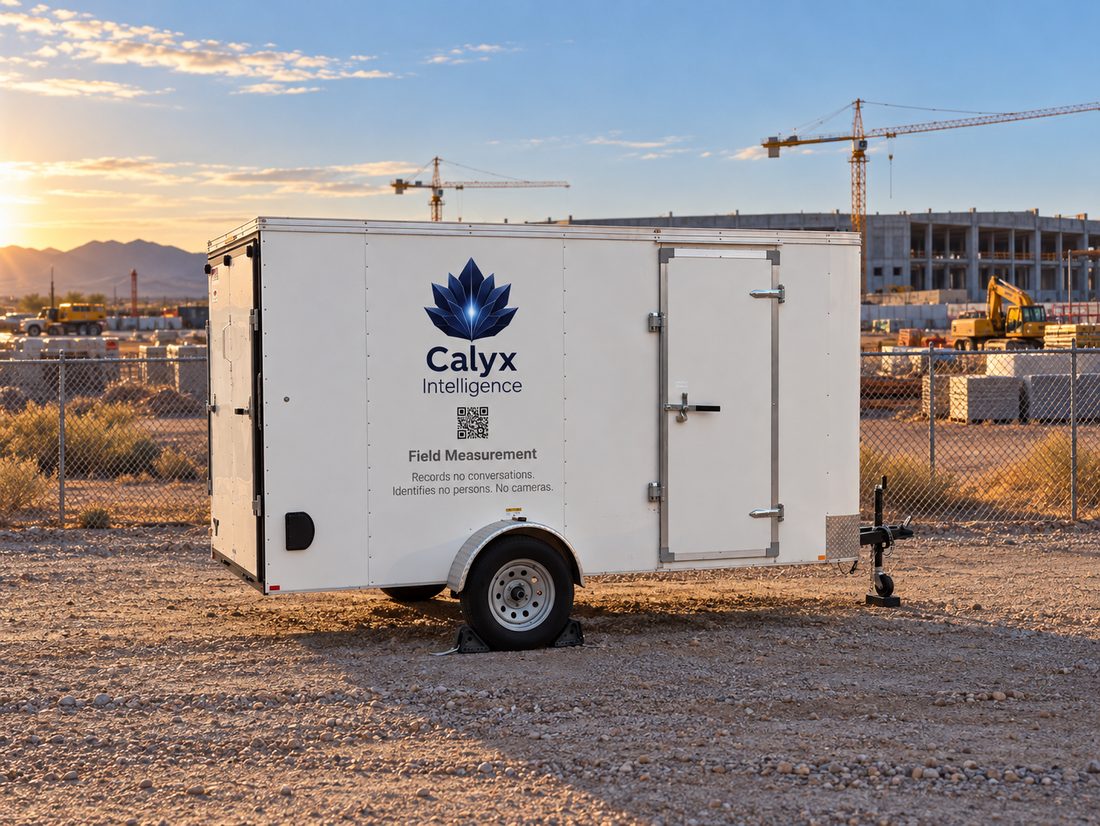
A data center is a communication site with a bigger power problem. The baseline window closes when construction starts.
Request a scope and quoteCalyx also publishes a public register of data center siting rules, including the measurement conditions some jurisdictions impose. How the two practices are kept separate: adjacency and disclosure.